Visit the SAP Forum

Languages : English | Dutch | French | Portugese | Italian

   SAP Tutorial  
  • Introduction
  • SAP History
  • SAP Facts
  • SAP Tables
  • SAP Function
  • SAP Report
  • Reasons To Use SAP
  • SAP Landscape
  • SAP Transaction Code
  • SAP Lotus Notes       Integration
  • Business Connector and       XML
  • Enterprise Release 4.7

  •  
    SAP Training Instituties
     
  • SAP Training Institutes
  • Job Consultants Address
  • SAP Companies Address

  •  
    Business Process Cycle
     
  • Analyze
  • Design
  • Implement
  • Operate
  • Optimize
  • Skills And Education

  •  
    Logistics Module
     
  • Sales and Distribution
  • Quality Management
  • Materail Management
  • Plant Maintenance
  • Financial Modules
          (FI/CO)
  • Project system
  • Production Planning
  • Service Management

  •  
    SAP NetWeaver
     
  • Introduction
  • Object Model
  • Interoperability
  • Creating Web Apps
  • Java Connector
  • Advantages & Conclusion
  • Life Cycle Management
  • Composite Application       Framework

  •  
    SAP Tools
     
  • SQL Trace Tool
  • SAP CRM
  • SAP SRM
  • SAP SCM
  • SAP ERP
  • SAP BW

  •  
    SAP Modules
     
  • SAP FI Module
  • SAP CO Module

  •  
    SAP Techanical
     
  • SAP ITS Architecture
  • Financial Management
  • Manufacturing Planning       and Execution
  • Customer Order       Management
  • Lackbox Processing
  • SD and Financial       Accounting Integration
  • SAP - HR (Human
          Resource)


  •  
    SAP Miscellanous
     
  • Web Application       Server(WAS)
  • Data Archiving
  • Mobile Engine
  • SAP Script
  • SAP Transactions
  • SAP Business
          Warehouse(BW)


  •  
    SAP Reference
     
  • SAP Facts
  • SAP Tables
  • SAP Function
  • SAP Report
  • SAP Landscape

  •  
    SAP others
     
  • SAP Treasury
  • SAP Finance
  • SAP WAS
  • SAP Data Archiving
  • SAP ALE
  • SAP EDI
  • SAP Exchange
  • SAP X-APPS
  • SAP Applications
          Components
  • SAP Software
  • Dunning
  • SAP IDES
  • SAP Payroll Basics
  • SAP BASIS and Security
         Authorization
  • SAP Backup
  • SAP Router

  •   ABAP Tutorials  
  • Introduction
  • ABAP Transaction
  • ABAP Function
  • ABAP File Processing
  • ABAP Objects
  • ABAP Syntax
  • ABAP Queries
  • SAPMail Usin ABAP
  • ABAP Programming Hints

  •   SAP Projects & Codes  
  • Finding the user-exits
  • Purchase Order Display
  • Batch Input
  • Dynamic Open SQL
  • Creating Extract Dataset
  • Reading database tables
  • load table from a UNIX file
  • Create subscreen

  •  
    SAP Resources
     
  • SAP Books
  • SAP Links

  •  
    Interview Question
     
  • Common Interview Que.
  • ABAP Interview Que.
  • ERP Interview Que.
  • HR Interview Que.
  • MM Interview Que.
  • PP Interview Que.
  • ALE Interview Que.
  • EDI Interview Que.
  • Basis Interview
          Questions
  • SAP-SD Interview
          Questions
  • FI&CO Interview
          Questions
  • BW Interview Questions
  • CRM Interview
          Questions
  • Interview Questions
  •  
    Careers at SAP
     
  • Careers in SAP (SAP Jobs)
  •    


    Customer Order Management


    A D V E R T I S E M E N T


    Share the Experience and Exchange Ideas

    HOME >> CUSTOMER ORDER MANAGEMENT
    Discussion Center

    Discuss

    Query

    Feedback/Suggestion

    Yahoo Groups

    Sirfdosti Groups

    Contact Us

    Introduction

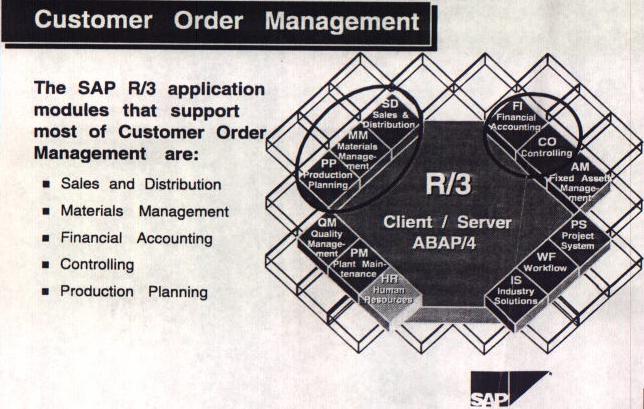
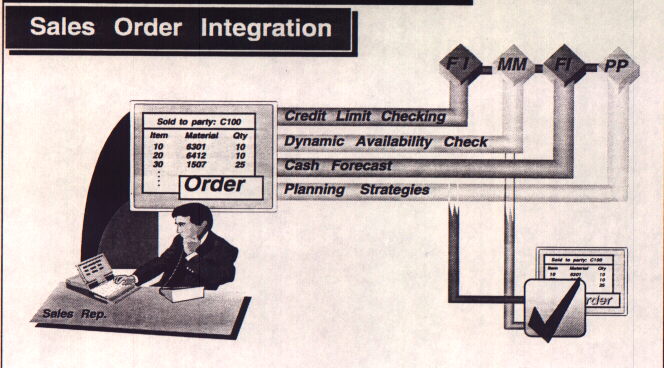
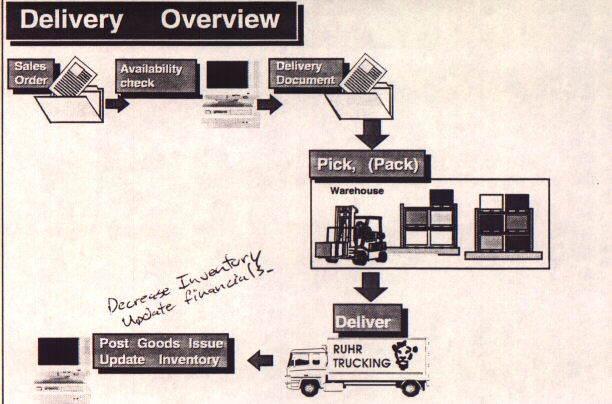
    One of the key strengths of enterprise management systems is the integration of business functions. This process starts with the contact with a potential customer. This process of customer ordering is at the heart of the information system. The chart above shows the integration of sales and distribution to capture the order and ship the goods, material management to control the inventory, financial accounting to manage the billing and flow of cash, controlling to measure the profitability of operations and production planning to ensure an economical flow of goods to inventory and customers.

    The logic of the organization of master data and other procedures in the system is built on Organizational elements. These are:

    • Company code--an independent accounting unit.
    • Sales organization-- responsible for marketing.
    • Distribution Channel-- the means though which sales material reaches the customer, e.g.wholesale, retail, etc.
    • Division--used to segment a business into lines.
    • Plant-- a manufacturing facility or warehouse.
    • Shipping point-- a fixed location that carries out shipping activities.

    Master Data contains the records that remain in the database over an extended period of time, are maintained centrally and shared across application modules to eliminate data redundancy.


    Customer Master Data is shared between the accounting and sales and distribution departments


    The system copies data from one document into another to reduce data entry and make problem resolution easier.

    The following interfaces are connected to the sales process:

    • Check to see if the customer has exceed the credit limit FI
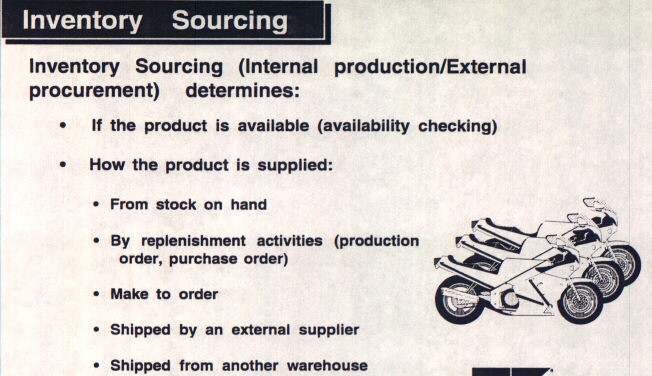
    • Checks to see if there is enough stock available for shipment MM
    • Updates the Cash Forecast FI
    • Creates production orders at sales order time PP


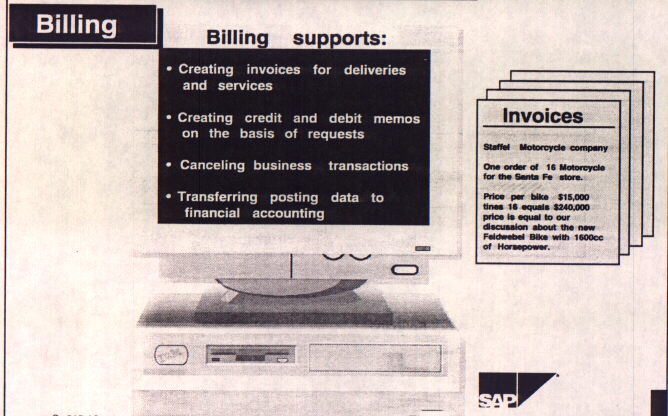
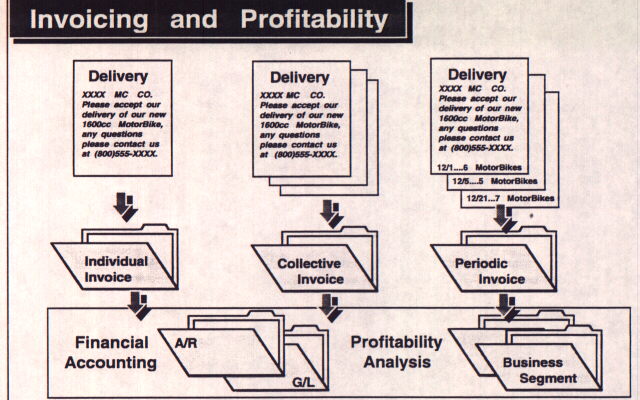
    Invoicing is a major interface point in the system:

    • FI updates the receivable and the inventory by automatic journal entries to the general ledger
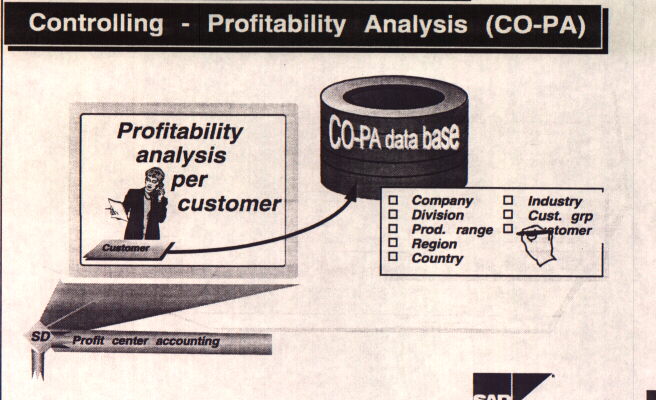
    • CO-PA updates profit center accounting to track the revenue and costs associated with the sale


    A D V E R T I S E M E N T


    Share the Experience and Exchange Ideas


    INTERVIEW EBOOK
    Get 9,000+ Interview Questions & Answers in an eBook. Interview Question & Answer Guide
    • 9,000+ Interview Questions
    • All Questions Answered
    • 5 FREE Bonuses
    • Free Upgrades
    START YOUR WEBSITE
    India's Best Web Hosting Company

    Copyright © 2006. One Stop SAP. All rights reserved
    The site is maintained by Vyom Technosoft. Sitemap (XML)